The general perspective
We have reached the era of computational gluttony. We can simulate galaxies, fold proteins in seconds, and generate prose that mimics the cadence of a Pulitzer winner—all via statistical brute force. But there is a persistent, nagging silence at the center of the machine. Despite the trillion-parameter architectures and the frantic “arms race” for compute, the machine remains a sophisticated mirror, not a source. It processes, but it does not know.
The mirage of the “thinking” machine
The current discourse around AI often falls into the trap of confusing complexity with consciousness. We see a model solve a complex coding problem and we attribute a “spark of life” to it. However, what we are witnessing is the pinnacle of pattern matching. These models operate within the boundaries of what is mathematically computable—a vast but ultimately finite playground.
True human intuition isn’t just “fast thinking” or a shortcut through data. It is a biological phenomenon that allows us to navigate ambiguity without a training set. When a creative director feels a “tug” toward a specific aesthetic, or a company founder changes a decision based on a “gut feeling” despite the data suggesting otherwise, they are accessing a layer of understanding that does not rely on previous iterations. The machine can only look backward; human intuition is our only tool for looking into the void of the truly new.
Why “good enough” is the new minimum
Because AI has democratized the ability to produce “average” quality work, the value of the 80% mark has plummeted to zero. If a machine can write a decent marketing strategy or a functional Python script for the cost of a few kilowatts, then “decent” is no longer a professional standard—it’s the floor.
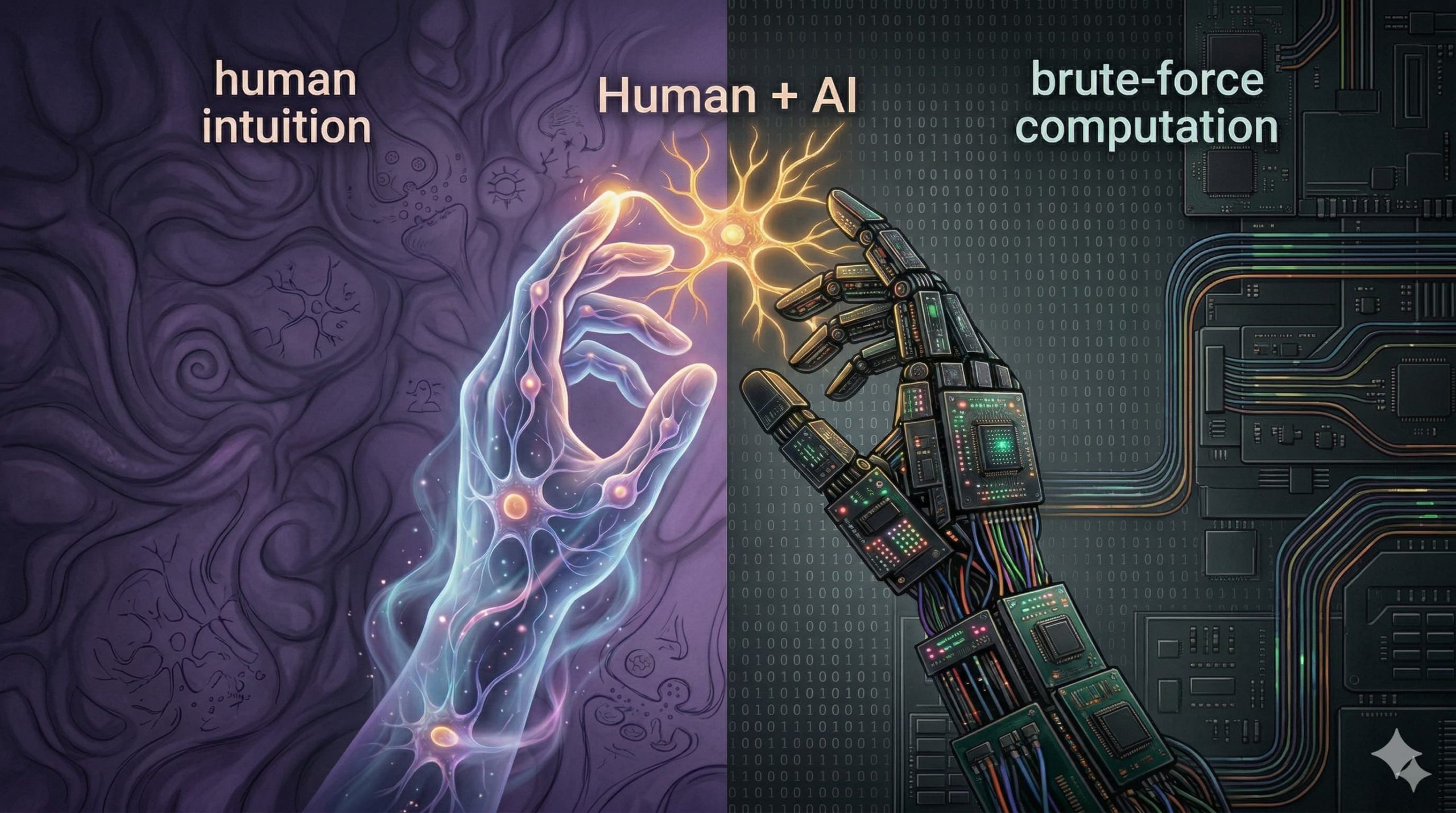
The competitive advantage has shifted to the outliers. In this environment, the “Human + AI” hybrid isn’t about letting the AI do the thinking; it’s about using the AI to handle the heavy lifting of execution so the human can focus on the high-variance, intuitive leaps that a deterministic system cannot replicate. We are moving from an era of builders to an era of curators and visionaries who use intuition to steer the massive power of computation. Taking this into account gives us a unique perspective to reconsider the impact of AI on the workforce.
The technical deep-dive
The non-computability of Insight
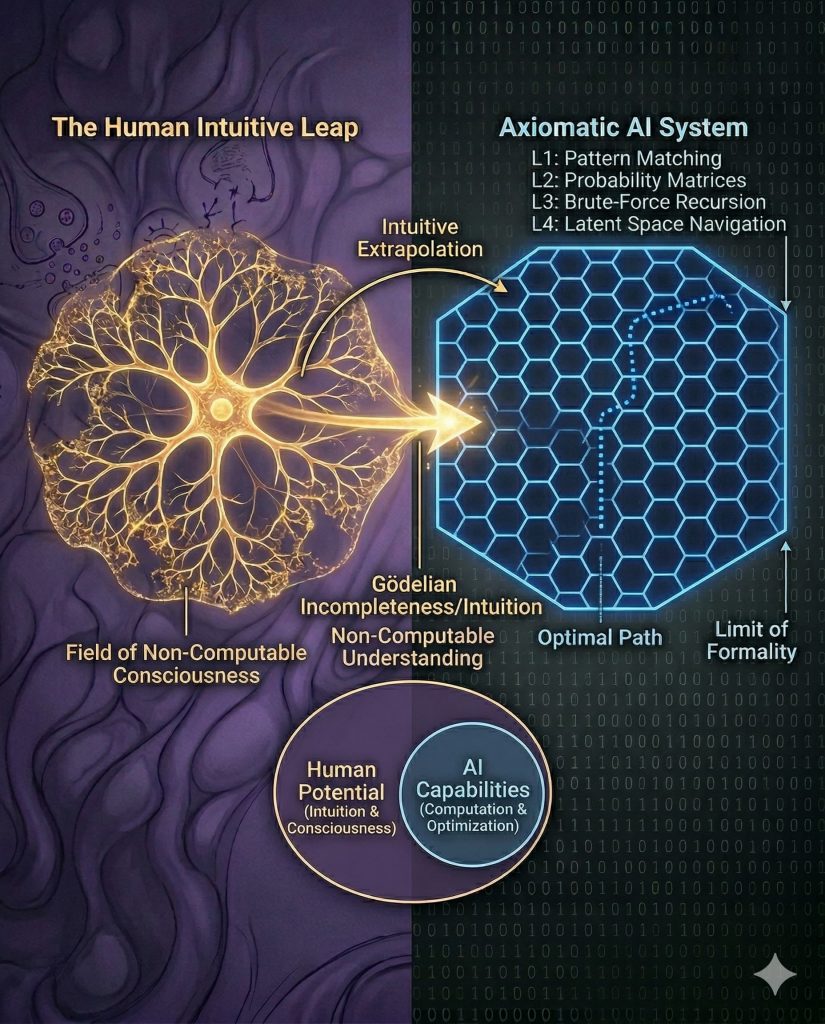
To understand why intuition remains a human stronghold, we must look at the limits of Turing-complete systems. Most modern AI is built on the premise that intelligence is entirely algorithmic. However, if we adopt the perspective that human consciousness—and by extension, genuine insight—is non-computable, the entire “AGI is around the corner” narrative begins to crumble.
The argument, popularized by figures like Roger Penrose, suggests that there is something inherent in the physical laws of the universe—perhaps at the quantum level within biological structures—that allows for “understanding” in a way that a discrete state machine (like a GPU-based LLM) cannot mimic. An algorithm follows a set of rules; it cannot “see” the truth of a mathematical statement that lies outside its own axiomatic system (as suggested by Gödel’s Incompleteness Theorems). When a human has an “eureka” moment, they aren’t just calculating faster; they are perceiving a truth that the system’s rules hadn’t yet defined.
Probabilistic vs. possibilistic frameworks
Current Large Language Models (LLMs) operate on a probabilistic framework. They predict the most likely next token based on a massive distribution of historical data. Intuition, however, is often possibilistic or even counter-probabilistic. It involves choosing the unlikely path because of a perceived qualitative value that isn’t represented in the frequency of the data.
Mathematically, we can describe the machine’s “creativity” as a traversal of a latent space. The AI can interpolate between known points  and
and  with incredible precision. But it cannot jump to point
  if point exists outside the manifold of its training data. Intuition is the bridge to that external point. As we increase the
  (the number of parameters), we simply fill the latent space more densely; we do not expand the boundaries of the space itself. That expansion remains a biological prerogative.
The Evolution of the Labor Market in the Face of AI
Opinion in the industry is shifting rapidly: value no longer resides in execution (which AI has turned into a commodity), but in the human ability to bring judgment and accountability. We are living through a paradigm shift where we are moving from rewarding “Skill” to rewarding “Judgment.” In this new landscape, the most in-demand profiles fall into three pillars:
The Problem Architect (Agency): The market is looking for professionals who don’t just “use” AI, but have the agency to own a problem from start to finish. While AI generates solutions, the human takes ownership and responsibility for the final outcome.
The Output Curator (Judgment): In the face of a saturation of “average” synthetic content, value shifts to those who have the judgment to filter out mediocrity. Companies seek experts who can validate whether a solution is ethical, aesthetically valuable, and aligned with market intuition.
The Possibilistic Visionary (Divergent Thinking): Since AI always proposes the most probable path based on past data, companies will reward those who dare to be counter-probabilistic. Success will come from leaders who use their intuition to bet on visions that algorithms cannot predict.
Conclusion: The ghost in the code
Ultimately, the architecture of intuition is not something we can reverse-engineer because it isn’t built on a foundation of logic. It is the product of a biological consciousness that is capable of “seeing” truth rather than just calculating probability. As we move deeper into a world saturated with synthetic content and automated reasoning, the premium on the human “hunch” will only rise. We must stop viewing AI as a replacement for our decision-making and start seeing it as a high-fidelity simulator—a tool that can map out the known universe so that we are free to step beyond its borders. Your competitive advantage isn’t your ability to process data; it’s your ability to know when the data is irrelevant. In the grand calculation of the future, the most valuable variable remains the one the machine can never solve: you.
“Intuition is the art, peculiar to the human mind, of working out the correct answer from data that is, in itself, incomplete or even, perhaps, misleading.” – Isaac Asimov