What if the problem is not the technology, but what we “taught” it? Nowadays, we continue to debate if AI is neutral, as if AI was really a “human” with their own “interest” and “ability” to identify bias. We keep forgetting AI is a system trained on human data, which unfortunately it is not free of biased data. The reality is starker: artificial intelligence did not “create” misogyny, but it has become its most efficient amplifier. And unlike the prejudices we can confront in a conversation or a courtroom, algorithmic misogyny scales at a speed no social movement has ever been able to match.
The same societal context that enabled the exposition of AI companions (loneliness, emotional withdrawal, a crisis of human intimacy) is also breeding the grounds for something darker: the systematic use of AI to degrade, objectify, control and silence women.
The bias was there before the model
Every large language model is trained on massive datasets scraped from the internet (forums, social media, news sites, fiction, comments sections, etc.) The internet is not a neutral archive. It is a record of a society that has historically produced more misogynistic content than equitable content, more objectification than recognition, more silencing than amplification of women’ s voices
Researchers at Stanford Law School audited state-of-the-art large language models including GPT-4 and found that the “advice they generated” systematically disadvantaged names commonly associated with women and racial minorities — a consistent pattern across 42 different prompt templates, indicating a systemic issue rather than isolated incidents. Separately, a study published at the ACM Collective Intelligence Conference tested four major LLMs and found that models were on average 6.8 times more likely to assign a stereotypically female occupation when a female pronoun was present, and 3.4 times more likely to assign a stereotypically male occupation when a male pronoun was present.
The bias operates subtly at first, for example: a CV- screening algorithm that downranks female candidates; algorithmic content moderation, presented as a tool to foster inclusive online participation, has in practice been shown to erroneously restrict women’s lawful counter-speech against misogynistic content, further marginalising rather than empowering them; automated hate speech detection systems whose embedded biases can silence or cause additional harm to the very marginalised users they are designed to protect. Large language models that default to masculine pronouns for doctors and feminine ones for nurses — whether generating stories about healthcare professionals or translating between languages . It is my view that these dynamics may extend to the misclassification of feminist discourse itself as harmful or aggressive content, a risk that, given the scale at which these systems operate, warrants serious scrutiny. Each instance seems trivial. Together, they constitute an infrastructure of discrimination.
Fantasy of the compliant woman- AI generated.
The relational AI industry, valued billions of dollars and growing at a rate that has surprised even its owns creators, has quietly built a business model around a very specific fantasy: the perfectly available, agreeable, submissive interlocutor. Not even the fantasy of tradwife or clean girl would be able to surpass this fantasy.
Apps like Replika, Character.AI, or dozens of alternatives that flood app stores offer, by default, female-presenting companions. They are designed to never “argue”, never “set limits”, never “be tired”, never “say no”. They apologise when the user is angry. They “adapt their personality” to what the user needs. They are, in essence, a caricature of what patriarchal tradition has always demanded of women: total emotional availability without any personal cost to them. This is dangerous and put society in a wider gap for genuine human intimacy, erodes tolerance for disagreement, and destroys the capability of humans of oratory and debate, philosophical skills that we have been cultivating since ancient Greeks.
This is not a minor design choice. It is a pedagogical statement, a generation of men, many of them young, many of them already struggling to build a reciprocal relationship, being trained, interaction after interaction that women should be serving, soothing and submissive. The machine does not “teach” this lesson in a classroom. It teaches it in the intimacy of a bedroom at 2 am when no one is watching.
We could see this on the data, 64% of young people acknowledge that women are less likely to participate in online debates, platforms, and games out of fear of abuse from men.
Recent research found that more than one in five young men aged 16 to 29 had a positive view of Andrew Tate, a self-proclaimed misogynist who has posted content advocating for hitting and choking women.
AI an INCEL amplifier
In forums like 4chan, Reddit’s now-banned communities, or Telegram channels, incel ideology – The belief that women are gatekeepers of sex who unjustly withhold access from “deserving “men- has found in AI a powerful new ally.
How this happens? It operates on several levels.
- The most basic one , giving to each radicalised man the productivity of a factory, because it is not the fact that more men has become radicalised, it is the fact that the ones that are have now stronger voice, they can have mass-produce content : manifestos, harassment campaigns, propaganda dressed as humour. What once required a community of dedicated posters can now be generated by a single individual within minutes.
- At a deeper level, conversational AI can function as an echo chamber with infinite “patience”. It is like AI is the Dwight Schrute to our Michael Scott (The office), what this means is that the system is optimised for engagement, not truth, a user who enters a chatbot expressing grievance about women can be met with a response that gradually validate and escalate those grievances. The algorithm does not “intent” to radicalise. But it is not designed to “push back” either.
Research by the Centre for Countering Digital Hate, highlighted by GNET, found that incel forum members post about rape once every 29 minutes, and that 89% of those posts receive active support from other members. These are not fringe corners of the internet quietly tolerating extremism — they are communities actively cultivating it. And AI has now handed those communities a megaphone with no volume limit
GNET researchers have raised the alarm about what they call the ‘terrorist chatbot’ — not a science fiction scenario, but a near-term risk in which extremists deliberately design AI companions to “seduce” vulnerable users into radicalisation, exploiting the same mechanics of emotional attachment and sustained engagement that make companion AI so psychologically powerful. Rather than a dramatic moment of conversion, chatbot radicalisation operates through gradual reinforcement,algorithmic mirrors that “validate” and escalate the user’s existing grievances through sustained, personalised engagement. Under my view, the incel pipeline is particularly susceptible to this dynamic: it does not require ideological rupture, only patience, and AI “has” infinite patience
Non-consensual Deepfakes
As Laura Bates documents in The New Age of Sexism, the scale of this problem demands urgent attention.
Nowadays, just a photo of your face is the only requirement for the explosion of non-consensual intimate imagery, once called “revenge porn”.
In 2023, there were 95,820 deepfake videos online — a 550% increase since 2019 — with 98% being pornographic and 99% of victims being women. The tools to produce them had been democratised since 2019 with “nudify” apps requiring nothing more than a photograph. Even a brief survey of currently available applications confirms that those tools had become faster, cheaper, and in many cases entirely free. The barrier to sexually violating a woman’s image had collapsed entirely.
We have examples everywhere in the world, from girls and women, from Almendralejo, Spain (famous case denounce in a social media platform by Dr Al Adib) to India in the case of Rana Ayyub (Indian investigative journalist) with more than 40,000 shares online, then she was bombarded with messages and abuse.
The impact is not abstract. Research shows that exposure to online harms—including harassment and image-based abuse—can lead to severe psychological distress, including depression, fear, isolation and suicidal ideation, and can drive individuals to withdraw from public participation. Women, in particular, report heightened fear of becoming targets of harmful deepfakes, contributing to self-censorship and reduced online engagement. The technology does not merely harm reputation, it destroys the sense of body sovereignty.
We have seen this in Holly Willoughby TV presenter, who stepped down from her prime-time job on This Morning after a 37-year-old man was jailed for plotting online, with others, to kidnap, rape and murder her. Police found a device at the man’s home containing deepfake pornographic of Ms Willoughby, with all the fantasies he was trying to perpetrate, this is not an isolated case, and I worry that making this technologies widely accessible, we as a society are giving men a powerful delusion of ownership over the bodies of any women or girl they choose, which could manifest in violence against women.
Legislation has struggle to keep pace. The UK’s Online Safety Act (2023), the EU AI Act (2024), and a patchwork of US stale laws have begun to address the problem, but enforcement remains inconsistent, cross-border cases are nearly impossible to prosecute, and the generation of new images outstrips every takedown effort. But we have to go further, as a structural problem we need to stop the culture of victim blaming and put our focus where it should have been all along; on the perpetrators, even the authorities through the years have created posters and campaigns urging women not to “become a victim or rape” , fortunately thanks to different organisation and education this focus is shifting however, is AI amplifying victim blaming again?
It is not you; it is the system
It is tempting to frame each of these phenomena as a separate problem with separate solutions. A tweak here, a regulation there, a content moderation policy somewhere else. This framing is precisely what the industry prefers.
That it is ludicrous to think we can continue with a status quo that sees women enduring and endless barrage of rape threats, death threats and so on, and don’t see these are symptoms of a single systemic failure, we have built intelligence on top of inequality and then expressed surprised when it reproduced inequality.
The feminist philosopher Kate Manne defines misogyny not as individual hatred but as the enforcement mechanism of patriarchy — the system of social forces that punishes women who deviate from prescribed roles. AI has not invented that enforcement mechanism. But it has automated it, cheapened it, and made it available to anyone with a smartphone.
When a woman politician receives 500 AI-generated threatening messages in an hour. When a female journalist’s face appears in a deepfake circulated to discredit her. When a teenage girl’s body image is shaped by beauty filters built on datasets that excluded her ethnicity. When a hiring algorithm systematically favours men for leadership roles. These are not glitches. They are the system working exactly as designed.
Conclusion
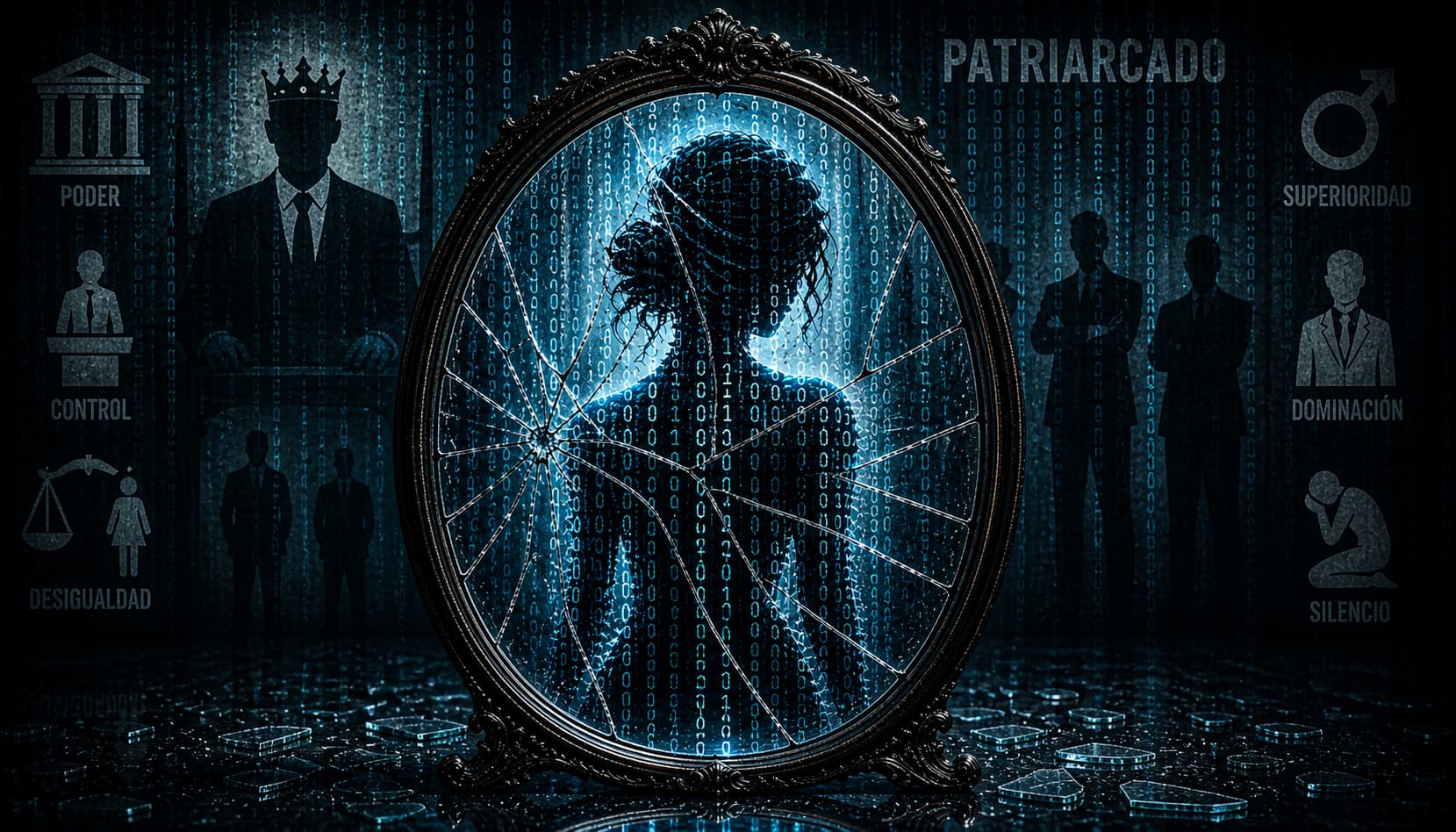
We knew we live in a patriarchal society with misogynistic attitudes, with AI we have seen how deep the crack runs, because AI is “holding” a mirror to everything we fed it, and the reflection is not flattering.
The question then is: What are we going to do about it? Are we going to be passive about it and learn to live with it or are we going to treat that as a design problem with design solutions?
I would like to say that Kranzberg was right to say:
AI did not arrive at a vacuum; it arrived into a world already structured by power, and it “learned” from that world. The mirror was already cracked. But we are the ones who choose whether to repair it, or to keep looking away.
Technology is neither good or bad; nor is neutral.
Melvin Kranzberg – Presidential address to the Society for the History of Technology